


Delhi World Public School, Greater Noida
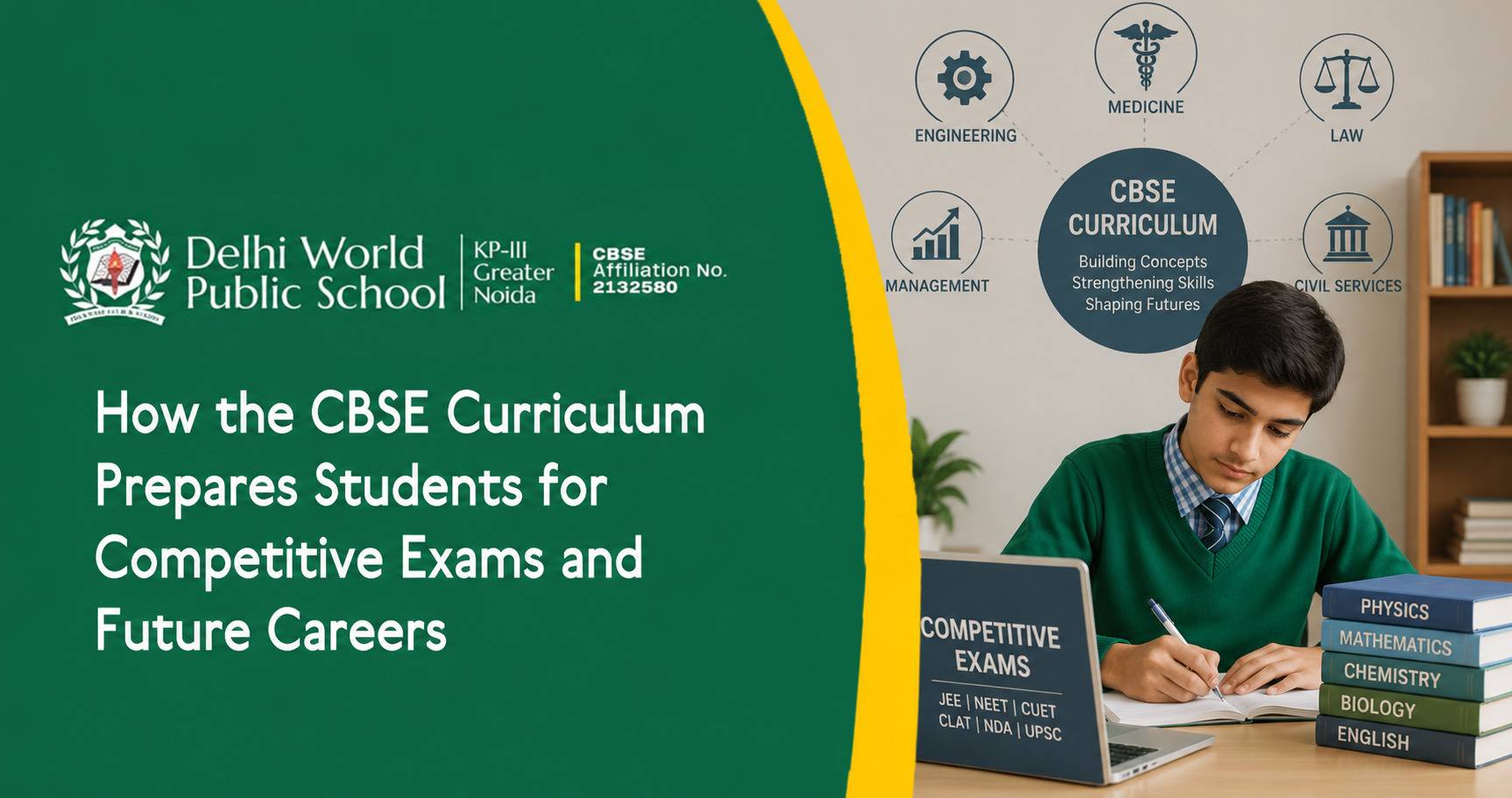
Understand how the CBSE curriculum strengthens conceptual learning and analytical thinking.
Learn why CBSE is considered highly effective for national-level competitive exam preparation.
Explore how skill-based education supports future career readiness.
Discover the importance of practical learning, time management, and problem-solving abilities.
Learn how modern educational environments help students balance academics with personal growth.
Find out why parents searching for the best cbse school often prioritize future-focused CBSE learning models.
Introduction
About Us
Why Is the CBSE Curriculum Widely Preferred by Parents?
How Does CBSE Help Students Prepare for Competitive Exams?
What Skills Does the CBSE Curriculum Develop for Future Careers?
Why Is Conceptual Learning Important for Long-Term Success?
How Do Extracurricular Activities Complement Academic Excellence?
Comparison Table: Traditional Learning vs CBSE Learning Approach
Conclusion
FAQs
The education landscape is rapidly evolving as students prepare for increasingly competitive academic and professional environments. At DWPS, the Best CBSE School in Greater Noida where today’s learners require more than textbook knowledge to succeed in higher education and future careers. They need strong conceptual understanding, analytical thinking, communication skills, adaptability, and problem-solving abilities. In this changing educational ecosystem, the CBSE curriculum has become one of the most trusted and preferred educational frameworks among parents and educators across India.
Delhi World Public School focuses on delivering a balanced educational experience that combines academic excellence with skill development, innovation, and holistic learning. The institution follows student-centered teaching methodologies that encourage conceptual understanding, critical thinking, creativity, and experiential learning.
The school aims to prepare students for competitive examinations, higher education opportunities, and future career success through a supportive and future-ready academic environment.
One of the biggest advantages of the CBSE curriculum is its student-friendly and nationally standardized academic structure. The curriculum is carefully designed to support progressive learning while reducing unnecessary academic pressure.
CBSE focuses on developing conceptual understanding and practical application of knowledge, which benefits students preparing for various entrance examinations and higher education opportunities.
Strong focus on conceptual clarity
Nationally recognized academic framework
Balanced academic structure
Emphasis on analytical and logical reasoning
Student-friendly examination patterns
Integration of practical and skill-based learning
Alignment with national competitive exams
These features make CBSE one of the most preferred educational boards for students aiming for academic and career success.
Competitive exams such as JEE, NEET, CUET, NDA, and other national-level entrance tests require deep conceptual understanding and strong problem-solving abilities. The CBSE curriculum aligns closely with the syllabus patterns of many of these examinations.
Students studying under the CBSE framework often gain an advantage because they become familiar with objective-based problem-solving, analytical thinking, and application-oriented learning methods from an early stage.
Students understand subjects deeply rather than memorizing information superficially.
The curriculum gradually develops complexity, helping students strengthen their fundamentals step-by-step.
Many national-level competitive exams are heavily based on NCERT textbooks prescribed by CBSE.
Examinations encourage reasoning, interpretation, and application of knowledge.
Modern careers require far more than academic scores. Employers and universities increasingly value creativity, communication, adaptability, leadership, and critical thinking skills.
The CBSE curriculum supports holistic student development by integrating academic learning with practical exposure, collaborative activities, and experiential education.
|
Skill |
How CBSE Supports It |
|
Critical Thinking |
Analytical and application-based questions |
|
Communication Skills |
Presentations and collaborative activities |
|
Time Management |
Structured assessments and projects |
|
Problem-Solving |
Practical and case-based learning |
|
Leadership |
Participation in school activities |
|
Adaptability |
Exposure to multidisciplinary learning |
Students become better prepared to handle both academic and professional challenges confidently.
Conceptual learning helps students understand the “why” behind every concept rather than simply memorizing answers for examinations. This approach improves retention, confidence, and independent thinking abilities.
Students with strong conceptual understanding often perform better in higher education because they can apply knowledge in practical situations and adapt to advanced learning environments more effectively.
Improves memory retention
Encourages independent learning
Strengthens analytical reasoning
Reduces exam-related stress
Builds confidence in solving unfamiliar problems
Supports lifelong learning habits
The CBSE curriculum’s emphasis on understanding-based learning helps students develop academic resilience and intellectual curiosity.
A balanced educational experience requires equal attention to academics, creativity, emotional growth, and physical well-being. CBSE schools increasingly encourage students to participate in sports, arts, debates, leadership programs, and co-curricular activities.
These experiences improve communication skills, confidence, teamwork, discipline, and emotional intelligence — qualities that are highly valuable in future academic and professional environments.
|
Aspect |
Traditional Learning |
CBSE Learning Approach |
|
Learning Style |
Memorization-focused |
Concept-oriented |
|
Examination Pattern |
Theory-heavy |
Application-based |
|
Student Participation |
Passive |
Interactive |
|
Competitive Exam Alignment |
Limited |
Strongly aligned |
|
Skill Development |
Moderate focus |
Holistic development |
|
Practical Learning |
Less emphasis |
Integrated learning approach |
The CBSE framework continues evolving to meet the demands of modern education and future career expectations.
The CBSE curriculum plays a vital role in preparing students for both competitive examinations and long-term career success. Its focus on conceptual clarity, analytical thinking, practical application, and holistic development helps students become confident learners capable of adapting to evolving academic and professional landscapes. As parents continue evaluating educational opportunities, schools that effectively implement the CBSE framework while supporting overall personality development are gaining greater importance.
1. Why is the CBSE curriculum considered effective for competitive exam preparation?
The curriculum focuses on conceptual understanding, analytical thinking, and NCERT-based learning that aligns with many national-level entrance examinations.
2. How does conceptual learning benefit students academically?
Conceptual understanding improves retention, logical reasoning, confidence, and the ability to solve application-based questions effectively.
3. What future-ready skills are developed through the CBSE curriculum?
Students develop communication, critical thinking, problem-solving, time management, adaptability, and leadership abilities.
4. How does the CBSE learning approach differ from traditional education systems?
CBSE emphasizes application-oriented learning, practical understanding, and skill development rather than memorization-focused teaching.
5. Why are extracurricular activities important alongside CBSE academics?
Extracurricular participation helps students improve creativity, discipline, teamwork, communication, and emotional intelligence.
6. How does the CBSE curriculum support long-term career readiness?
The curriculum encourages analytical learning, independent thinking, practical application, and balanced development needed for future academic and professional success.


