


Delhi World Public School, Greater Noida
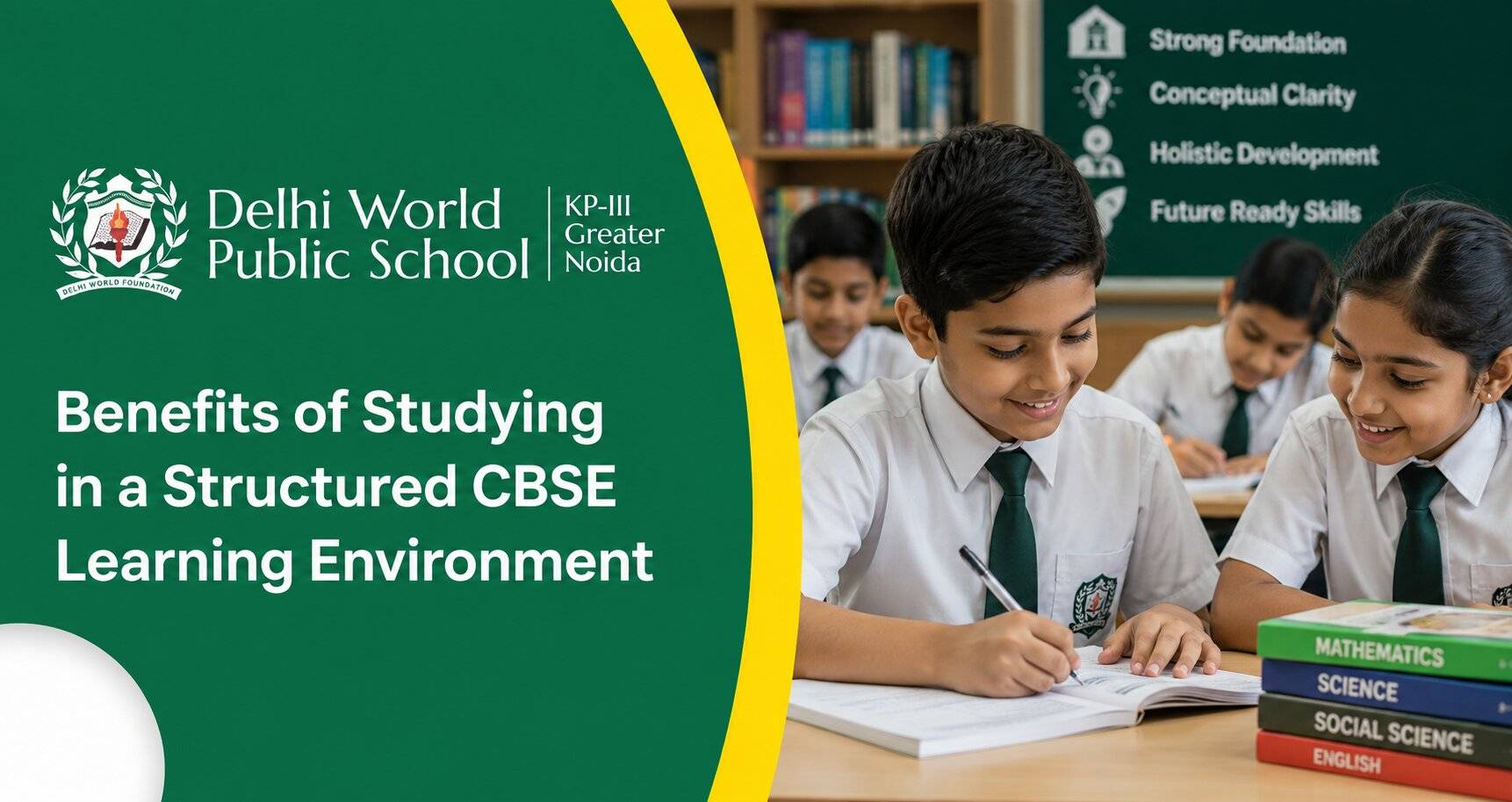
Structured CBSE education promotes conceptual understanding and academic consistency.
Students benefit from a balanced curriculum that supports both scholastic and co-scholastic development.
CBSE's learner-centric approach enhances critical thinking and problem-solving abilities.
Standardized learning frameworks prepare students for competitive examinations and higher education.
Holistic development programs foster leadership, communication, and life skills.
A structured learning environment builds discipline, confidence, and future readiness.
Introduction
About Us
Why Is a Structured CBSE Learning Environment Important?
How Does the CBSE Curriculum Support Academic Excellence?
Can a Structured Learning Environment Improve Life Skills?
How Does CBSE Education Prepare Students for Future Opportunities?
Benefits of a Structured CBSE Framework
Conclusion
FAQs
Education plays a pivotal role in shaping a student's academic journey, personality, and future aspirations. At DWPS, the Top CBSE School in Greater Noida where parents today are increasingly looking for educational institutions that provide not only strong academic foundations but also a nurturing environment where children can develop essential life skills. A structured CBSE learning environment offers a well-balanced educational framework that supports intellectual growth, character development, and holistic learning.
Delhi World Public School is committed to delivering a well-rounded educational experience that nurtures academic excellence, creativity, leadership, and character development. Students actively participate in sports competitions, cultural programs, innovation initiatives, literary activities, and community engagement projects that enrich their learning journey. The school emphasizes experiential learning, technology integration, and holistic development to ensure every learner develops the skills and confidence needed for future success. Through a supportive and engaging environment, students are empowered to become responsible, confident, and globally aware individuals.
A structured learning environment provides students with a clear academic roadmap, helping them understand expectations, goals, and learning outcomes at every stage of their educational journey.
The CBSE framework follows a carefully designed curriculum that ensures consistency and continuity in learning. This structure helps students build strong foundational knowledge while progressively developing advanced concepts.
Organized curriculum progression
Consistent academic standards
Better learning discipline
Improved classroom engagement
Enhanced student accountability
Clear assessment methodologies
Students benefit from a learning ecosystem where academic objectives are aligned with overall development, creating a strong foundation for lifelong learning.
One of the major strengths of the CBSE curriculum is its focus on conceptual clarity rather than rote memorization. Students are encouraged to understand topics deeply and apply their knowledge in practical situations.
The curriculum incorporates project work, activity-based learning, and continuous assessments to evaluate a student's overall understanding.
|
Feature |
Student Benefit |
|
Concept-Based Learning |
Better understanding of subjects |
|
Standardized Curriculum |
Consistency across institutions |
|
Skill-Based Assessments |
Practical application of knowledge |
|
Integrated Learning |
Strong interdisciplinary understanding |
|
National Recognition |
Smooth transition across schools |
This approach not only improves academic performance but also develops analytical and critical-thinking abilities that are essential for future success.
Academic achievement alone is not enough in today's competitive world. Students also need communication skills, leadership qualities, emotional intelligence, and adaptability.
A structured CBSE environment integrates co-curricular and extracurricular activities that contribute significantly to personality development.
Effective communication
Team collaboration
Leadership and responsibility
Problem-solving abilities
Time management
Emotional resilience
Decision-making skills
Through classroom interactions, group projects, sports participation, cultural events, and leadership opportunities, students learn valuable skills that help them navigate real-life challenges confidently.
|
Development Area |
Key Outcome |
|
Academic Growth |
Strong subject knowledge |
|
Social Skills |
Better collaboration |
|
Emotional Growth |
Increased confidence |
|
Leadership |
Decision-making abilities |
|
Communication |
Effective expression |
|
Character Building |
Responsibility and ethics |
Such comprehensive development ensures students are prepared not only for examinations but also for future responsibilities.
Can a structured educational framework influence long-term success? The answer is undoubtedly yes.
The CBSE curriculum is designed to align with national entrance examinations and higher education requirements. Students gain exposure to problem-solving techniques, analytical reasoning, and application-based learning that are highly relevant for competitive exams.
Preparation for national-level competitive examinations
Strong foundation for higher education
Enhanced digital literacy and research skills
Greater adaptability to changing career landscapes
Development of innovation and creativity
Exposure to real-world learning experiences
Students also benefit from career awareness programs, technology integration, and experiential learning opportunities that help them explore future pathways with confidence.
|
Educational Component |
Benefit |
|
Curriculum Planning |
Consistent academic growth |
|
Assessments |
Continuous performance improvement |
|
Co-Curricular Activities |
Holistic development |
|
Technology Integration |
Digital readiness |
|
Value Education |
Ethical development |
|
Career Guidance |
Future preparedness |
Balanced focus on academics and personal growth
Nationally recognized curriculum
Enhanced learning outcomes
Improved student confidence
Better preparation for future challenges
Opportunities for holistic development
A structured framework ensures students receive comprehensive support throughout their educational journey.
A structured CBSE learning environment offers far-reaching benefits that extend beyond academic achievement. Through a well-organized curriculum, skill-based learning, holistic development opportunities, and future-focused educational practices, students gain the knowledge, confidence, and competencies necessary for long-term success.
1. Why is Delhi World Public School considered a CBSE School?
Delhi World Public School combines a structured CBSE curriculum with holistic development programs, helping students achieve academic excellence while building essential life skills.
2. How does Delhi World Public School compare with other CBSE schools in terms of academic structure?
Compared to many institutions, Delhi World Public School follows a balanced approach that emphasizes conceptual understanding, skill development, and experiential learning.
3. Does Delhi World Public School provide better holistic development opportunities than traditional schools?
The school integrates academics, sports, arts, leadership activities, and technology-driven learning, creating a more comprehensive educational experience.
4. How does Delhi World Public School prepare students for competitive examinations compared to other schools?
Students benefit from a strong conceptual foundation, analytical learning methods, and structured academic support that align with national-level examination requirements.
5. What makes the CBSE learning environment at Delhi World Public School different from other educational institutions?
The school focuses on student-centered learning, continuous assessment, life skills development, and future readiness alongside academic achievement.
6. Why do parents choose Delhi World Public School over other CBSE schools?
Parents appreciate the school's commitment to academic excellence, character building, leadership development, and holistic student growth within a structured learning environment.


