


Delhi World Public School, Greater Noida
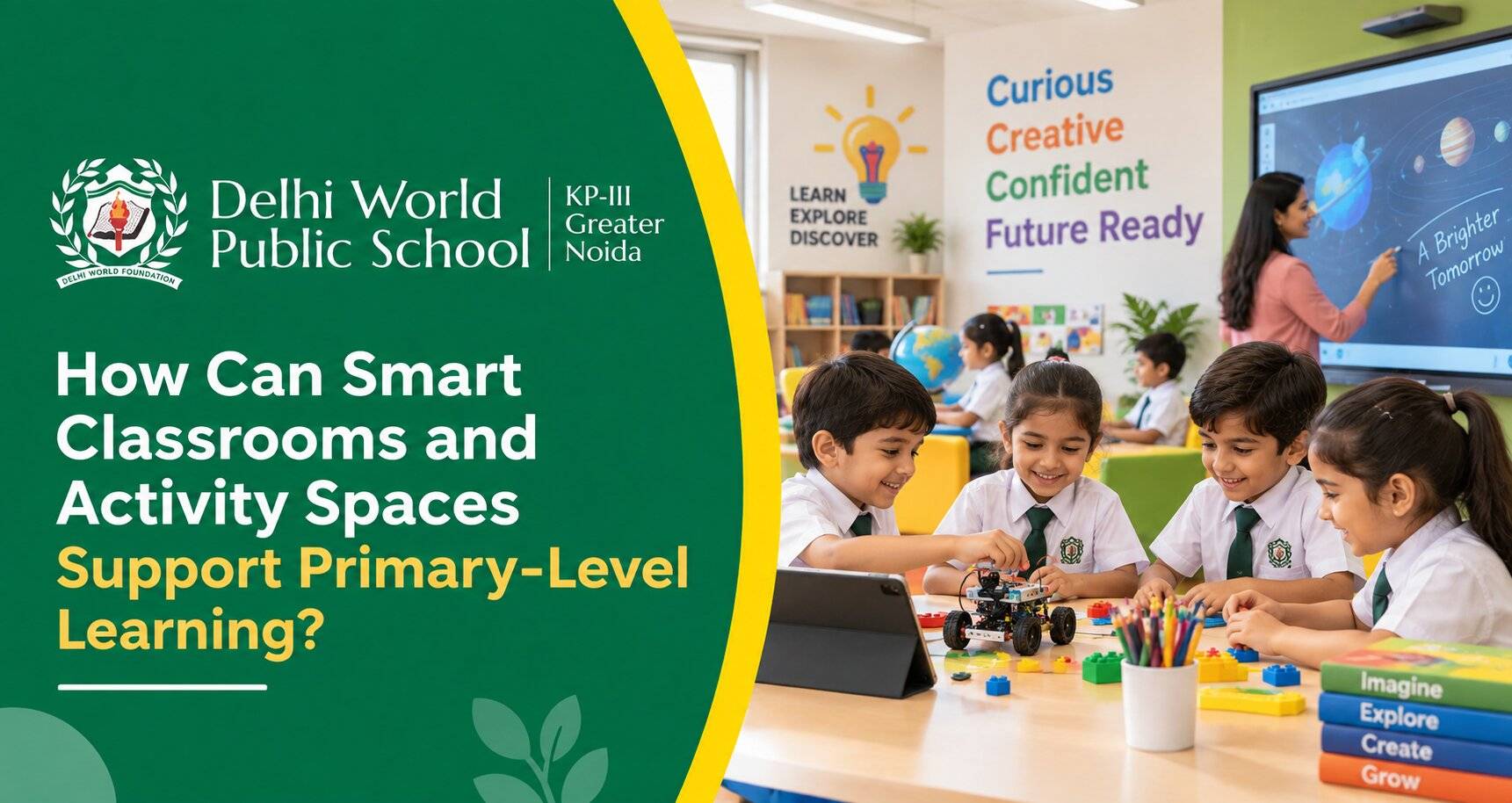
A primary classroom is often where children begin forming their earliest ideas about what learning feels like. Is it something to memorise, or something to explore? Can a lesson be seen, touched, discussed and experienced?
When parents compare a Good Primary School in Greater Noida, or explore options in other regions, it is useful to look beyond whether a campus simply has smart boards or digital screens. At Delhi World Public School, Greater Noida, the more meaningful question is: How are technology and activity-based spaces actually used to support a child’s understanding, creativity and confidence?
Founded in 2016, the institution is part of the Delhi World Foundation and follows the Guru-Shishya philosophy while focusing on holistic education and learner progress. Its educational environment is supported by school leadership, teachers and staff working towards academic and overall student development.
The school's mission encourages curiosity, exploration, experimentation and observation while extending learning into activity workshops, resource centres, laboratories and libraries. Its vision combines Indian values with world culture and aims to develop responsible global citizens.
Primary-age children learn through different experiences. A concept may become clearer when it is demonstrated visually, discussed with classmates, explored through an activity or connected with something familiar from everyday life.
Its primary programme also emphasises activities intended to create interest and motivation among students, helping learning become an active experience rather than a purely passive one.
A smart classroom is most effective when technology helps a teacher explain a concept in a way that is easier for children to understand.
For example, a visual representation can support a science lesson, an animated demonstration can make a mathematical concept easier to follow, and multimedia content can add context to topics that may otherwise feel abstract.
However, technology should not replace the teacher.
The real value lies in how it is used.
A teacher can pause a visual explanation, ask children questions, encourage discussion and connect digital content with an activity or practical task. This combination can make learning more interactive while keeping the teacher at the centre of the educational experience.
Children do not develop understanding only by listening. They also learn by doing, making, observing, questioning and collaborating.
Activity spaces can give primary learners an opportunity to move beyond theoretical knowledge. A science concept can be explored through experimentation. A creative task can encourage imagination and expression. Group activities can help children practise communication and cooperation.
This approach is especially relevant during the primary years, when children are building foundational skills as well as attitudes towards learning.
The goal should not be to keep children busy. A well-planned activity should have a learning purpose and help students connect experience with understanding.
Smart classrooms and activity spaces should not function as two separate parts of school life. The strongest learning experiences often combine both.
Imagine students first watching a visual explanation of a scientific process. They can then discuss their observations with the teacher, perform a simple activity and finally share what they discovered. In this process, technology introduces or illustrates the concept, while hands-on learning allows children to engage with it more actively.
This balance is important because young children still need opportunities to write, read, discuss, play, create and interact with the world around them. Digital tools can support these experiences, but they should be used purposefully and appropriately.
A campus visit gives parents an opportunity to look beyond promotional claims.
Instead of simply asking, “Do you have smart classrooms?”, consider asking:
Parents should also observe the atmosphere. Are children encouraged to ask questions? Do classroom displays reflect student work? Are activity spaces designed for participation rather than only occasional events?
These observations can provide a more realistic picture of everyday learning.
Smart classrooms can make primary learning more visual and interactive, while activity spaces can give children opportunities to explore ideas through experience. However, neither facility is valuable simply because it exists.
The difference lies in how teachers, technology and learning spaces work together.
At Delhi World Public School, Greater Noida, for parents searching for a Good Schools in Greater Noida, the comparison should go beyond digital screens and impressive infrastructure. Look for evidence of active participation, conceptual understanding, meaningful activities and teachers who can guide children through different ways of learning.
Smart classrooms can use visual and multimedia resources to help children understand concepts, participate in discussions and engage more actively with lessons.
They allow children to learn through exploration, practical tasks, creativity, collaboration and hands-on experiences.
No. Technology works best as a teaching tool that supports teacher guidance, discussion and meaningful classroom interaction.
Parents should observe classrooms, activity areas, library resources and how technology is integrated into everyday learning.
It allows children to apply ideas, experiment, solve problems and connect academic concepts with practical experiences.
Effective classrooms combine appropriate digital resources with skilled teaching, active participation and opportunities for hands-on learning.


