


Delhi World Public School, Greater Noida
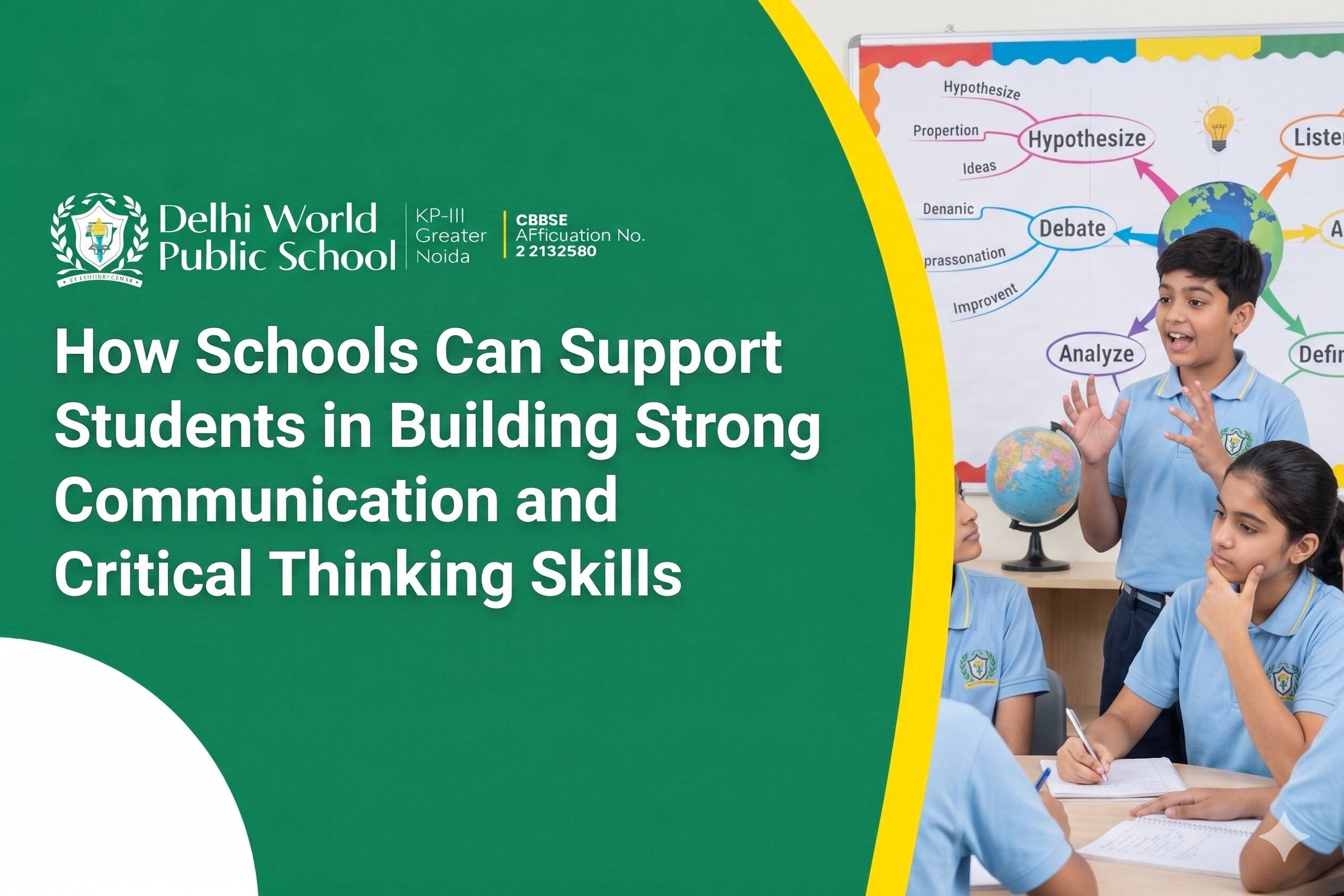
Understand why communication and critical thinking are essential for future success.
Learn how modern schools develop confidence, creativity, and analytical abilities in students.
Explore classroom strategies that improve problem-solving and decision-making skills.
Discover the importance of collaborative learning, debates, and experiential education.
Learn how future-focused educational environments prepare students for academic and professional challenges.
Find out why parents searching for the Best School prioritize skill-based learning approaches.
Introduction
About Us
Why Are Communication and Critical Thinking Important for Students?
How Can Schools Improve Communication Skills?
What Teaching Methods Strengthen Critical Thinking Abilities?
Why Does Experiential Learning Play a Major Role?
How Do Extracurricular Activities Support Skill Development?
Comparison Table: Traditional Learning vs Skill-Based Learning
Conclusion
FAQs
Education today is evolving beyond textbooks, memorization, and examination scores. At DWPS, the Best School in Greater Noida where in a rapidly changing global environment, students require a broader set of skills that help them adapt confidently to academic, social, and professional challenges. Among the most important abilities students need are strong communication skills and critical thinking capabilities. These competencies empower learners to express ideas clearly, analyze situations logically, solve problems effectively, and make informed decisions in real-life situations.
Delhi World Public School focuses on nurturing students through a balanced educational approach that integrates academic excellence with communication development, critical thinking, creativity, and experiential learning. The institution encourages collaborative learning environments where students are motivated to express ideas confidently, solve problems independently, and participate actively in both academic and extracurricular activities.
The school’s student-centered philosophy emphasizes holistic development, leadership, innovation, and future-ready learning experiences designed to support lifelong success.
Communication and critical thinking are foundational life skills that influence every aspect of a student’s personal and professional journey. Effective communication helps students express thoughts confidently, build relationships, and participate actively in learning environments.
Critical thinking, on the other hand, enables students to analyze information, evaluate different perspectives, and solve problems independently. Together, these skills prepare children to become adaptable, confident, and responsible individuals.
Enhances confidence and self-expression
Improves academic performance
Strengthens problem-solving abilities
Encourages independent decision-making
Develops leadership and teamwork qualities
Builds creativity and innovation
Supports emotional and social growth
Students who develop these skills early often perform better in collaborative and real-world situations later in life.
Schools play a significant role in helping students become confident communicators. A supportive and interactive learning environment encourages students to share ideas, ask questions, and participate actively in classroom discussions.
Teachers can create opportunities for verbal and written communication through presentations, storytelling, group discussions, debates, and collaborative projects. These activities help students improve vocabulary, listening abilities, articulation, and public speaking confidence.
Encouraging open discussions helps students learn how to express ideas respectfully and confidently.
Team projects improve listening, cooperation, and interpersonal communication abilities.
Presentations, assemblies, and debates strengthen verbal communication and confidence.
Drama, storytelling, and creative writing activities help students improve articulation and imagination.
Critical thinking develops when students are encouraged to question, explore, and analyze rather than simply memorize information. Schools that use inquiry-based and experiential teaching methods create opportunities for deeper understanding.
Instead of providing direct answers, educators can guide students to evaluate information, compare perspectives, and identify solutions independently. This approach develops analytical reasoning and decision-making skills.
|
Teaching Method |
Skill Developed |
|
Project-Based Learning |
Problem-solving and research |
|
Case Studies |
Analytical reasoning |
|
Open-Ended Questions |
Independent thinking |
|
Science Experiments |
Observation and evaluation |
|
Debate Sessions |
Logical argument development |
|
Brainstorming Activities |
Creativity and innovation |
These methods encourage active participation and deeper engagement with learning concepts.
Experiential learning allows students to learn through practical experiences rather than passive instruction. Activities such as field visits, simulations, role-play exercises, hands-on experiments, and collaborative assignments improve retention and understanding.
This approach also encourages students to connect theoretical knowledge with real-world applications, making learning more meaningful and engaging.
Encourages curiosity and exploration
Improves memory retention
Develops adaptability and creativity
Strengthens observation and reasoning skills
Enhances collaboration and communication
Makes learning enjoyable and interactive
Students exposed to experiential learning environments often become more independent and confident learners.
Extracurricular activities provide students with additional opportunities to develop communication and critical thinking skills beyond the classroom. Participation in sports, debates, theatre, quizzes, and leadership programs strengthens confidence and teamwork abilities.
Such activities also encourage students to handle challenges, think strategically, and communicate effectively in competitive and collaborative situations.
|
Activity |
Skill Enhancement |
|
Debate Competitions |
Public speaking and reasoning |
|
Theatre and Drama |
Expression and confidence |
|
Sports Activities |
Teamwork and decision-making |
|
Quiz Competitions |
Analytical thinking |
|
Leadership Programs |
Responsibility and communication |
Balanced participation in academics and extracurricular activities contributes significantly to holistic student development.
Strong communication and critical thinking skills are essential for students to succeed in an increasingly competitive and rapidly evolving world. Schools that promote interactive learning, collaboration, creativity, and analytical reasoning help students become confident learners and capable decision-makers. As parents continue evaluating educational options, institutions that focus on holistic skill development alongside academic achievement are gaining greater importance.
1. Why are communication skills important for students in modern education?
Strong communication abilities help students express ideas confidently, collaborate effectively, and perform better academically and socially.
2. How do schools encourage critical thinking among students?
Project-based learning, discussions, debates, brainstorming activities, and problem-solving exercises help students think analytically and independently.
3. What classroom activities improve communication development?
Presentations, storytelling sessions, group projects, debates, and interactive discussions improve verbal and interpersonal communication skills.
4. How does experiential learning strengthen analytical abilities?
Hands-on learning activities encourage observation, reasoning, decision-making, and practical application of concepts.
5. Why are extracurricular activities important for personality development?
Sports, theatre, quizzes, and leadership programs improve confidence, teamwork, strategic thinking, and creativity.
6. How does skill-based learning benefit students in the long term?
Skill-based learning prepares students for higher education and future careers by improving adaptability, communication, and independent problem-solving abilities.


