


Delhi World Public School, Greater Noida
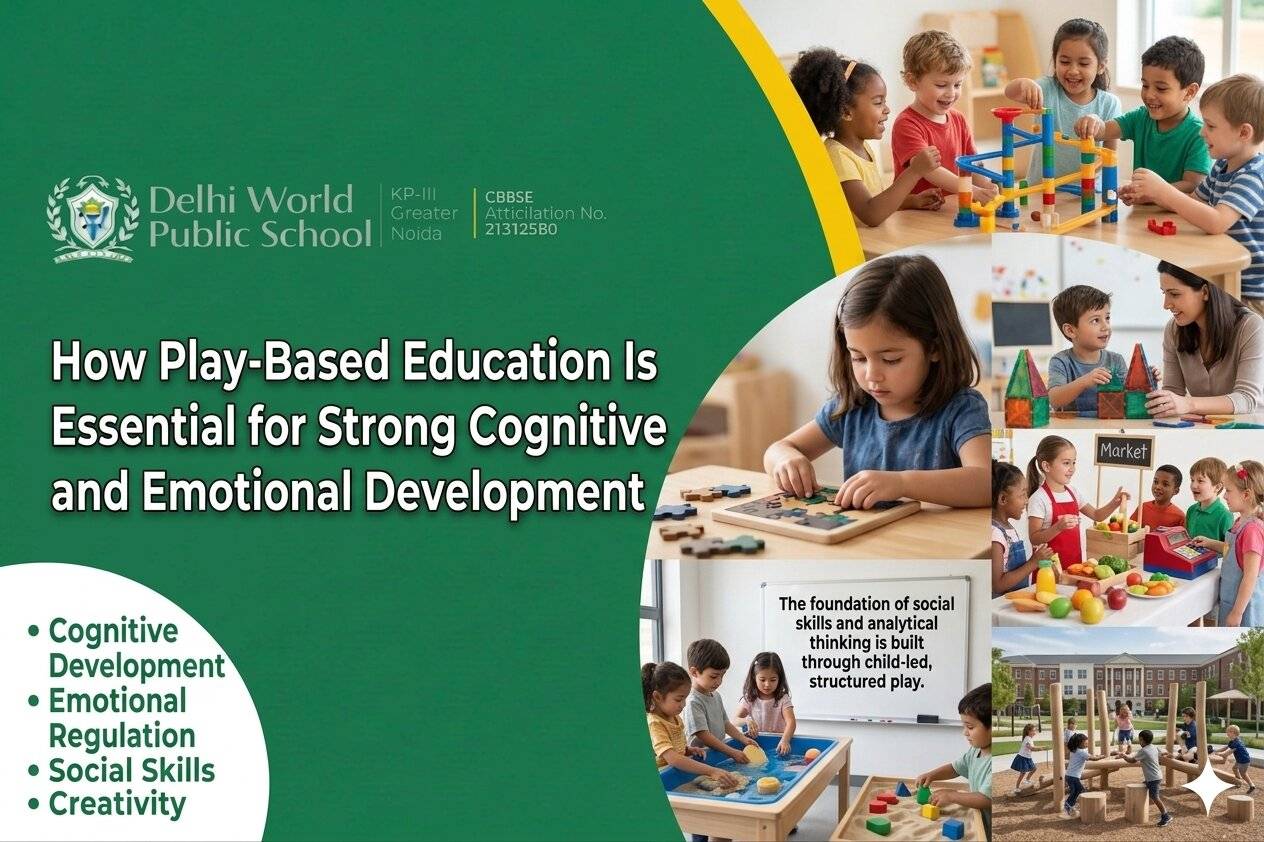
Understand how play-based learning improves brain development in early childhood.
Explore the emotional and social benefits of interactive learning methods.
Learn why creativity, communication, and problem-solving begin through play.
Discover how structured play enhances confidence, curiosity, and independence.
Find out why modern parents prioritize experiential learning in the best preschool.
Learn how early play experiences prepare children for long-term academic success.
Introduction
About Us
Why Is Play-Based Education Important in Early Childhood?
How Does Play Improve Cognitive Development?
Can Play-Based Learning Strengthen Emotional Intelligence?
What Role Does Social Interaction Play in Child Development?
How Do Creative Activities Build Future Skills?
Comparison Table: Traditional Learning vs Play-Based Learning
Conclusion
FAQs
Early childhood is one of the most critical stages of human development. During these formative years, children absorb information rapidly, build emotional connections, and develop essential life skills that shape their future personalities. At DWPS, the Best school in Greater Noida where modern educational approaches are increasingly moving away from rigid memorization and focusing more on experiential learning methods that encourage exploration, curiosity, and creativity. Among these methods, play-based education has emerged as one of the most effective approaches for holistic child development.
At Delhi World Public School, the focus is on nurturing young learners through engaging, child-friendly educational practices that support intellectual, emotional, social, and creative development. The learning environment is designed to encourage curiosity, confidence, communication, and independent thinking through interactive experiences and age-appropriate activities.
The institution emphasizes holistic growth by integrating academics with creativity, collaboration, and experiential learning methods that prepare children for future academic journeys and life challenges.
Children learn best when they are actively involved in experiences that stimulate their imagination and curiosity. Play provides opportunities for children to think independently, solve problems creatively, and express emotions freely.
Unlike passive learning methods, play-based education engages multiple areas of brain development simultaneously. Activities such as puzzles, pretend play, building blocks, sensory exploration, and group games help children understand concepts more effectively while keeping them emotionally connected to the learning process.
Encourages natural curiosity and exploration
Develops language and communication abilities
Improves attention span and concentration
Builds confidence through self-expression
Strengthens emotional regulation
Promotes teamwork and social interaction
Enhances physical coordination and motor skills
Cognitive development refers to a child’s ability to think, reason, remember, and solve problems. Play-based learning supports cognitive growth because children engage actively rather than simply listening to instructions.
For example, activities involving sorting, counting, storytelling, and role-playing stimulate memory retention and logical thinking. Creative games also improve decision-making abilities and analytical skills from an early age.
|
Play Activity |
Cognitive Skill Developed |
|
Building Blocks |
Problem-solving and spatial awareness |
|
Storytelling |
Language and memory enhancement |
|
Puzzle Games |
Logical reasoning |
|
Art and Craft |
Creativity and concentration |
|
Music and Rhythm Activities |
Pattern recognition and listening skills |
|
Pretend Play |
Imagination and critical thinking |
Children participating in play-oriented classrooms often become more independent learners because they develop confidence in experimenting and discovering answers on their own.
Emotional development is equally important as academic growth during the early years. Children must learn how to express feelings, understand emotions, and interact positively with others.
Play creates a safe environment where children experience joy, frustration, excitement, patience, empathy, and cooperation naturally. Through guided activities and social interaction, they gradually learn emotional regulation and healthy communication.
Helps children express emotions confidently
Reduces fear and learning anxiety
Encourages empathy and compassion
Develops patience and resilience
Builds self-esteem and emotional security
Creates positive classroom experiences
Children who engage in collaborative games and creative activities often develop stronger emotional adaptability, which later helps them handle academic challenges and social situations more effectively.
Social development begins early, and preschool environments play a significant role in shaping interpersonal skills. Group play activities teach children how to communicate, share, cooperate, and resolve conflicts constructively.
Interactive learning experiences also encourage children to become active listeners and respectful communicators. These early social experiences help children build friendships and improve their confidence in group settings.
Children learn teamwork naturally during collaborative games and classroom activities.
Storytelling, discussions, and role-playing improve verbal expression and listening abilities.
Play situations teach children how to negotiate, solve disagreements, and respect boundaries.
Interactive activities encourage decision-making and responsibility.
Parents often prefer learning environments that emphasize social engagement because strong interpersonal skills contribute significantly to future success.
Creativity is no longer viewed as an optional skill. In today’s rapidly changing world, innovation, adaptability, and independent thinking are essential qualities for success.
Creative play encourages children to think beyond fixed patterns. Activities like drawing, imaginative storytelling, dance, pretend play, and music stimulate imagination while strengthening cognitive flexibility.
|
Creative Activity |
Long-Term Skill Developed |
|
Dramatic Role Play |
Communication and leadership |
|
Art Activities |
Innovation and creativity |
|
Group Projects |
Collaboration and teamwork |
|
Sensory Exploration |
Observation and curiosity |
|
Music and Dance |
Confidence and expression |
These experiences create a strong foundation for academic learning and lifelong personal growth.
|
Aspect |
Traditional Learning |
Play-Based Learning |
|
Learning Style |
Teacher-directed |
Child-centered |
|
Classroom Engagement |
Passive participation |
Active exploration |
|
Emotional Development |
Limited focus |
Strong emphasis |
|
Creativity |
Structured |
Encouraged freely |
|
Social Skills |
Minimal interaction |
Collaborative learning |
|
Problem-Solving |
Instruction-based |
Discovery-based |
The growing preference for experiential learning demonstrates why many parents seek institutions that combine academics with interactive developmental activities.
Play-based education is far more than entertainment; it is a scientifically supported approach that strengthens cognitive abilities, emotional intelligence, creativity, communication, and social development during the most important years of childhood. By learning through exploration and interaction, children become more confident, curious, resilient, and adaptable learners.
1. How does play-based learning improve cognitive development in young children?
Interactive activities, storytelling, puzzles, and role-play help children strengthen memory, creativity, reasoning, and problem-solving abilities naturally.
2. Why do many parents prefer play-oriented preschool education today?
Play-based learning creates a stress-free environment where children learn communication, teamwork, and emotional confidence while enjoying the learning process.
3. How is play-based education different from traditional early learning methods?
Unlike rote learning, this approach encourages exploration, imagination, hands-on experiences, and active participation in classroom activities.
4. Can play activities help children develop social skills effectively?
Yes, collaborative games and group interaction teach children sharing, empathy, communication, and cooperation from an early age.
5. How does a child-centered learning environment support emotional growth?
Supportive classrooms encourage self-expression, confidence-building, emotional security, and independent participation in daily activities.
6. Why is experiential learning considered important for early childhood education?
Experiential learning helps children retain concepts better while developing curiosity, adaptability, and foundational life skills for future academic growth.


